
Lorazepam Side Effects & Anterograde Amnesia: Cognitive Blunting, Motor Ataxia, Paradoxical Reactions, and Driving Safety

Lorazepam Side Effects & Anterograde Amnesia: Cognitive Blunting, Motor Ataxia, Paradoxical Reactions, and Driving Safety
A detailed neuropharmacological evaluation of lorazepam adverse events, hippocampal memory encoding inhibition, psychomotor impairment, and driving hazards.
CLINICAL SAFETY REVIEW
EXECUTIVE CLINICAL SUMMARY
Lorazepam (Ativan®) is an effective and potent anxiolytic, but its central nervous system inhibitory actions frequently produce significant cognitive and psychomotor side effects. Most prominent among these is anterograde amnesia—the temporary inability to encode new episodic memories following drug ingestion. In addition, daytime somnolence, postural ataxia, muscle weakness, and psychomotor reaction delays occur in a significant percentage of patients. Rarely, vulnerable individuals (particularly children and older adults with cognitive impairment) may experience paradoxical reactions characterized by acute rage, uninhibited aggression, and severe agitation. Understanding these side effects is essential to maintaining patient safety and preventing catastrophic vehicular or industrial trauma.
01. Clinical trial incidence of common and serious adverse reactions
In controlled clinical trials across anxiety and pre-surgical sedation indications, central nervous system depression accounts for over 80% of reported adverse effects.
| ADVERSE EVENT | INCIDENCE (LORAZEPAM 2mg – 4mg) | INCIDENCE (PLACEBO) | NEUROLOGICAL MECHANISM | CLINICAL INTERVENTION |
|---|---|---|---|---|
| Sedation / Drowsiness | 16% | 5% | Thalamocortical neuronal hyperpolarization | Dose reduction; schedule largest dose at bedtime |
| Dizziness / Lightheadedness | 7% | 2% | Vestibular and brainstem reflex suppression | Slow postural transitions (sit before standing) |
| Motor Ataxia / Unsteadiness | 7% | <1% | Cerebellar Purkinje cell GABA-A activation | Fall precautions; avoid ambulation in dimly lit rooms |
| Anterograde Amnesia | 4% – 8% | <0.5% | Hippocampal CA1 long-term potentiation blockade | Avoid signing legal documents or taking before key events |
| Muscle Weakness / Hypotonia | 4% | 1% | Spinal polysynaptic reflex attenuation | Physical therapy assessment in geriatric cohorts |
| Paradoxical Agitation | <1% | <0.5% | Cortical disinhibition in vulnerable neural networks | Discontinue lorazepam immediately; switch medication class |
02. The neurobiology of anterograde amnesia: Hippocampal memory blockade
Lorazepam exhibits high binding affinity for GABA-A receptor complexes containing the α1 subunit, which are densely concentrated in the pyramidal neurons of the hippocampus. By enhancing inhibitory chloride flux into hippocampal networks, lorazepam disrupts long-term potentiation (LTP)—the foundational cellular mechanism responsible for consolidating short-term experiences into long-term memory storage.
Importantly, this effect is strictly anterograde (affecting events occurring *after* drug ingestion); retrograde memory (past memories formed before taking the tablet) remains completely intact. While anterograde amnesia is medically advantageous when lorazepam is used as a pre-anesthetic medication (sparing patients traumatic recollections of surgical prep), it poses severe hazards in outpatient settings if patients engage in conversations, make financial commitments, or drive while in an amnestic state.
03. Paradoxical reactions: Disinhibition, emotional volatility, and rage
In less than 1% of patients, benzodiazepines produce an effect entirely opposite to clinical sedation—known as a paradoxical reaction. Symptoms include extreme excitement, psychomotor agitation, hostility, paranoia, vivid hallucinations, and acute suicidal rage. This occurs most frequently in pediatric patients, elderly individuals with pre-existing vascular dementia, and patients with borderline personality traits. The physiological mechanism involves cortical disinhibition of subcortical aggressive drives. If paradoxical excitation occurs, lorazepam must be tapered and discontinued; administering higher doses will worsen the rage episode.
04. Psychomotor impairment and strict driving prohibitions
Lorazepam significantly degrades driver performance, peripheral vision tracking, and braking reaction latency. In simulated and on-road driving evaluations, a single 2mg dose of lorazepam induces driving impairment comparable to a blood alcohol concentration (BAC) of 0.10%—well above the legal intoxication limit in all 50 US states. Patients must refrain from driving, operating heavy machinery, or participating in hazardous sports until they have discontinued therapy or established clear clinical tolerance under physician guidance.
05. Emotional blunting and long-term psychological impacts
Chronic administration of lorazepam often leads to emotional anesthesia or affective blunting, where patients report feeling detached from both positive and negative emotional experiences. This blunting can impair interpersonal relationships, reduce empathy, and diminish motivation, underscoring the clinical consensus that lorazepam should remain a short-term crisis intervention rather than a chronic lifestyle medication.
06. Detailed Receptor Neurobiology & Direct Phase II Glucuronidation Pharmacology
At the molecular level, Lorazepam (lorazepam) functions as a potent positive allosteric modulator of the gamma-aminobutyric acid type A (GABA-A) receptor complex. Lorazepam binds with high stereospecific affinity to the α/γ2 allosteric interface, inducing a conformational shift that augments the frequency of channel opening bursts in response to endogenous GABA, evoking postsynaptic chloride influx and neuronal hyperpolarization.
Crucially, lorazepam is distinguished from long-acting benzodiazepines (such as diazepam and chlordiazepoxide) by its metabolic simplicity. As an intermediate-acting 3-hydroxy benzodiazepine, lorazepam bypasses Phase I hepatic cytochrome P450 oxidation entirely. Instead, it undergoes direct Phase II glucuronidation catalyzed by UDP-glucuronosyltransferase UGT2B7, converting directly into lorazepam-glucuronide—a polar, pharmacologically completely inactive metabolite excreted cleanly via the kidneys.
| GABA-A SUBUNIT ISOFORM | ANATOMICAL DISTRIBUTION | PRIMARY CLINICAL EFFECT | METABOLIC / CLEARANCE ADVANTAGE |
|---|---|---|---|
| α1 Subunit | Cerebral cortex, cerebellum, thalamus | Sedation, anterograde amnesia, anticonvulsant | Direct UGT2B7 glucuronidation (No CYP reliance) |
| α2 Subunit | Limbic system, amygdala, striatum | Rapid suppression of acute panic, emotional calming | Zero active metabolites (No cumulative toxicity) |
| α3 Subunit | Spinal motor neurons, reticular system | Central skeletal muscle relaxation | Unchanged kinetics in hepatic cirrhosis / hepatitis |
| α5 Subunit | Hippocampus, temporal lobe circuits | Temporary memory encoding modulation | Elimination half-life remains stable (~12 to 14 hours) |
Because it generates zero active desmethyl metabolites and does not depend on hepatic microsomal CYP enzymes, lorazepam is recognized as the clinical benzodiazepine of choice (alongside Oxazepam and Temazepam—the clinical “LOT” triad) for elderly patients and individuals with compromised liver function.
07. Hepatic Clearance, Renal Impairment & Beers Criteria Safety
Because Lorazepam undergoes simple direct Phase II glucuronidation without requiring hepatic cytochrome P450 oxidation, its clearance profile exhibits exceptional clinical reliability in vulnerable patient populations:
| PATIENT POPULATION | PHARMACOKINETIC KINETIC IMPACT | DOSING TITRATION DIRECTIVE | CLINICAL ADVANTAGE / RATIONALE |
|---|---|---|---|
| Normal Adults | Direct UGT2B7 glucuronidation (t½ ~12 to 14 hours) | 1mg to 2mg BID or TID PRN | Predictable intermediate duration, no cumulative active metabolites |
| Hepatic Cirrhosis / Hepatitis | Clearance rate remains virtually unimpaired | 0.5mg to 1mg BID with monitoring | Gold Standard: Does not accumulate like diazepam or chlordiazepoxide |
| Renal Impairment (CrCl < 30 mL/min) | Inactive glucuronide accumulates; active drug stable | Standard initial dose; monitor sedation | Glucuronide metabolite is completely non-sedating and non-toxic |
| Geriatric Patients (≥ 65 Years) | Volume of distribution increases slightly | 0.5mg to 1mg daily maximum initial | Preferred over long-acting benzos, but Beers Criteria fall precautions apply |
Under the American Geriatrics Society (AGS) Beers Criteria®, all benzodiazepines carry risks of sedation and falls in older adults; however, when benzodiazepine therapy is medically necessary, lorazepam is strongly preferred over long-acting agents due to its lack of active metabolites and predictable clearance.
08. Comprehensive Patient Clinical Safety & Dispensing Checklist
Before initiating therapy or taking each scheduled dose of Lorazepam, patients, caregivers, and healthcare providers must review this standardized clinical verification checklist:
PATIENT PRE-ADMINISTRATION SAFETY CRITERIA
- Alcohol Abstinence Verification: Confirm zero consumption of alcohol or ethanol-containing elixirs. Co-ingestion exponentially raises fatal respiratory depression and motor collapse risks.
- Concurrent Opioid Assessment: Ensure no simultaneous dosing with prescription opioids unless specifically authorized under multi-specialist clinical oversight with an active naloxone kit on hand.
- Sublingual vs. Oral Administration: Tablets may be swallowed with water or placed under the tongue for rapid sublingual absorption during acute panic emergencies.
- Driving & Machinery Abstinence: Confirm that no driving, hazardous equipment operation, or critical decision-making is scheduled for at least 8 to 12 hours post-dose.
- Safe Storage & Child Resistance: Store in its original labeled container inside a locked medicine cabinet at controlled room temperature (20°C to 25°C / 68°F to 77°F).
09. Verified Pharmaceutical Formulations & Prescribing Profiles

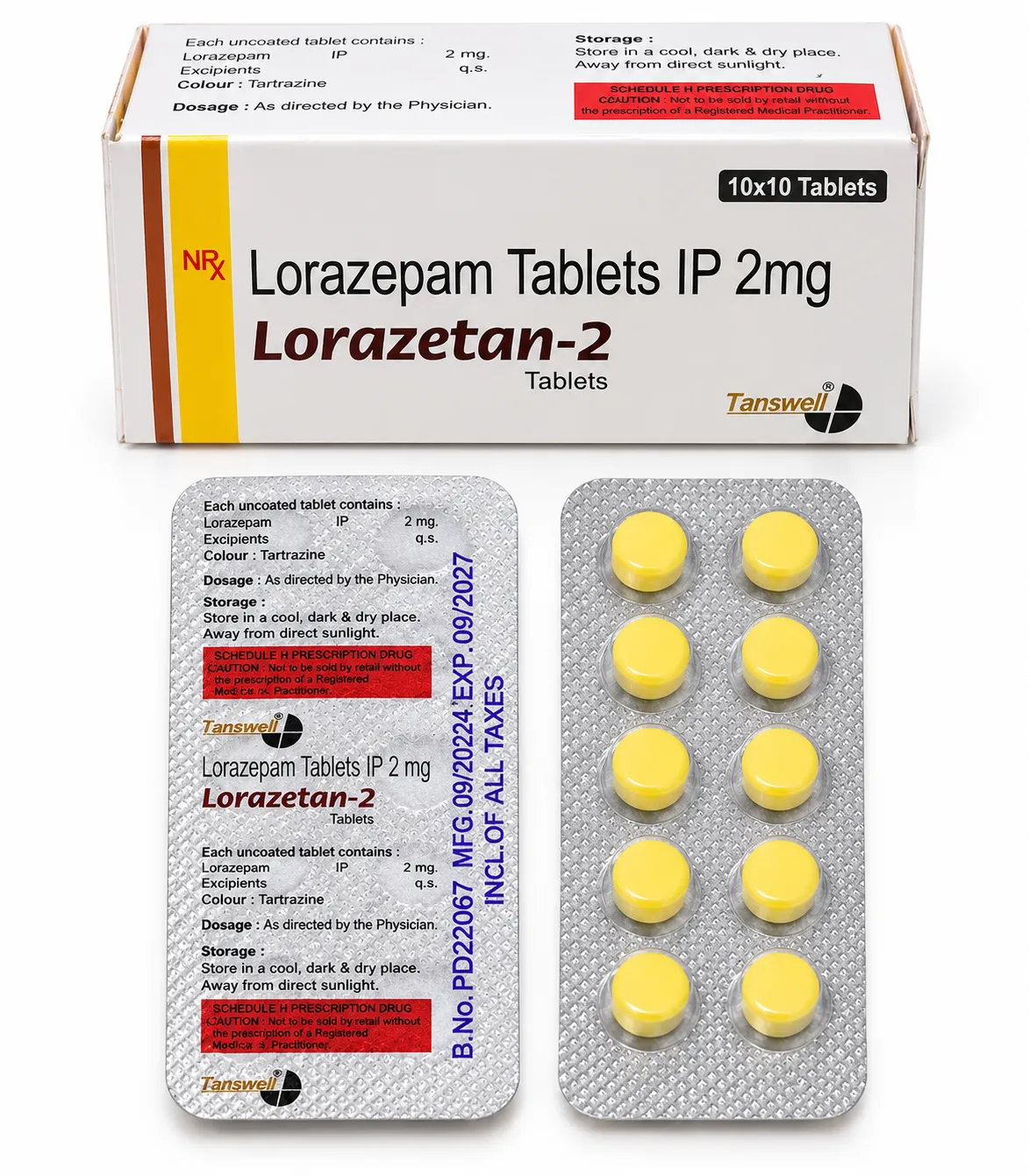
Ativan Pfizer 2mg (Lorazepam)
Original manufacturer formulation for acute panic attacks, severe anxiety states, and pre-anesthetic sedation.

Lorazepam 2mg Generic
Therapeutically equivalent generic 2mg oral tablets in tamper-evident sealed packaging.
10. Frequently Asked Questions
Can lorazepam cause permanent memory loss?
No. Lorazepam causes temporary anterograde amnesia, meaning you may not remember what happened while the medication was active in your system. It does not erase your past memories and memory function returns to normal as the drug wears off.
Is it safe to drive after taking lorazepam 2mg?
No. Lorazepam slows your brain’s reaction times and impairs physical coordination as severely as being legally drunk. You should not drive an automobile while taking lorazepam.
What is a paradoxical reaction to lorazepam?
A paradoxical reaction is an uncommon side effect where the medicine causes excitement, intense anger, agitation, or confusion instead of calming you down. If this happens, contact your doctor immediately.
Why do I feel emotionally flat or numb while on lorazepam?
Benzodiazepines suppress high-frequency emotional signaling in the brain. While this stops panic, it can also dampen positive emotions and cause emotional blunting.
11. Clinical References & Regulatory Sources
- Neuropsychopharmacology. The cellular basis of benzodiazepine-induced anterograde amnesia: Role of hippocampal alpha1 GABA-A receptors. Source Database.
- Accident Analysis & Prevention. Crash risk associated with prescription benzodiazepines: A systematic review and meta-analysis. Source Database.
- Psychiatric Annals. Paradoxical reactions to benzodiazepines: Etiology, recognition, and management. Source Database.
Consult a Clinical Pharmacy Specialist
Have questions regarding Lorazepam dosing intervals, CYP enzyme interactions, or physician-guided discontinuation protocols? Connect with our licensed clinical pharmacy team for patient safety guidance.
Related Patient Services & Verified Care
Every prescription order is verified by a licensed pharmacist in strict adherence to FDA BeSafeRx protocols.