
Lorazepam Tapering Schedule: The Ashton Method, Diazepam Substitution Protocols, and Safe Deprescribing

Lorazepam Tapering Schedule: The Ashton Method, Diazepam Substitution Protocols, and Safe Deprescribing
A comprehensive clinical tapering guide for safe, gradual lorazepam discontinuation, avoiding protracted withdrawal and rebound panic.
CLINICAL DEPRESCRIBING PROTOCOL
EXECUTIVE CLINICAL SUMMARY
Discontinuing lorazepam (Ativan®) after prolonged daily administration represents one of the most challenging deprescribing tasks in clinical psychiatry. Because lorazepam has an intermediate half-life (12 to 16 hours) and high GABA-A receptor potency (1mg lorazepam ≈ 10mg diazepam), attempting to taper off lorazepam directly often causes severe inter-dose withdrawal, rebound panic, sensory hyperacusis, autonomic instability, and seizure risk. The gold-standard clinical strategy for benzodiazepine discontinuation is the Ashton Method—which systematically cross-tapers the patient onto an equivalent dose of the long-acting benzodiazepine diazepam (Valium®), followed by gradual 10% dose reductions every 1 to 2 weeks.
01. Why direct lorazepam tapering is clinically problematic: The half-life barrier
Direct tapering off lorazepam poses significant pharmacodynamic hurdles:
- Inter-dose rebound: Because lorazepam levels drop significantly within 12 hours, patients experience acute mini-withdrawals between doses, causing severe daytime spikes in adrenaline and anxiety.
- Small tablet splitting limitations: With 1mg and 2mg tablets, accurately shaving off a 0.1mg or 0.2mg decrement is virtually impossible with home pill cutters, leading to erratic dosing cuts.
- High milligram potency: 1mg of lorazepam is equivalent to 10mg of diazepam; a standard 0.5mg tablet cut represents a massive 5mg diazepam drop, precipitating acute withdrawal distress.
02. The Ashton Protocol: Stepwise cross-over from lorazepam to diazepam
Developed by Professor C. Heather Ashton at Newcastle University, this protocol gradually replaces lorazepam with diazepam over 3 to 4 weeks, establishing smooth 24-hour plasma levels via diazepam’s active metabolites.
| TAPER STAGE | MORNING DOSE | MID-DAY DOSE | NIGHTTIME DOSE | TOTAL DAILY DIAZEPAM EQUIVALENT | CLINICAL GOAL |
|---|---|---|---|---|---|
| Baseline | Lorazepam 1mg | Lorazepam 1mg | Lorazepam 1mg | 30mg Diazepam Eq. | Establish stable baseline daily dosing |
| Stage 1 (Week 1-2) | Lorazepam 1mg | Lorazepam 1mg | Diazepam 10mg | 30mg Diazepam Eq. | Substitute evening lorazepam with long-acting diazepam |
| Stage 2 (Week 3-4) | Diazepam 10mg | Lorazepam 1mg | Diazepam 10mg | 30mg Diazepam Eq. | Substitute morning lorazepam; maintain mid-day dose |
| Stage 3 (Week 5-6) | Diazepam 10mg | Diazepam 10mg | Diazepam 10mg | 30mg Diazepam Eq. | Complete 100% cross-over to diazepam 30mg daily |
| Stage 4 (Week 7-8) | Diazepam 10mg | Diazepam 8mg | Diazepam 10mg | 28mg Diazepam | Begin 2mg bi-weekly diazepam dose reductions |
| Stage 5 (Week 9-16) | Stepwise -2mg every 1-2 weeks across daytime doses | – | Maintain evening dose last | 10mg to 20mg Diazepam | Gradual steady decompression of GABA-A receptors |
| Stage 6 (Week 17-24) | Diazepam 1mg – 2mg daily | – | Diazepam 1mg – 2mg bedtime | 2mg to 4mg Diazepam | Final low-dose titration; liquid diazepam if necessary |
| Cessation (Week 25+) | 0mg | 0mg | 0mg | 0mg | Full discontinuation; evaluate non-pharmacological therapies |
03. Direct lorazepam reduction protocol (When diazepam cross-over is contraindicated)
In clinical situations where diazepam is contraindicated (such as severe liver cirrhosis or paradoxical reactions to diazepam), direct lorazepam tapering is conducted using specialized liquid suspension formulations or compounding pharmacies. Reductions are restricted to no more than 5% to 10% of the current dose every 14 to 21 days, holding the dose steady if severe withdrawal emerges.
04. Managing benzodiazepine withdrawal symptoms: Somatic vs. psychological manifestations
A patient undergoing a gradual taper should be educated on expected, non-dangerous withdrawal phenomena:
- Sensory Hyperacusis: Sensitivity to bright lights, loud noises, and skin touch as sensory filtering pathways recalibrate.
- Muscle Fasciculations: Minor twitching in the calves, face, or eyelids.
- Sleep Architecture Fragmentation: Vivid dreams and REM sleep rebound during the first 3 to 5 days of each dose drop.
- Adjunctive Non-GABA Medications: Clinicians may prescribe non-addictive adjunctive agents—such as propranolol for autonomic tremors and heart palpitations, or gabapentin/pregabalin for somatic nerve tension.
05. The dangers of abrupt cessation: Seizures, psychosis, and delirium tremens
Abruptly stopping lorazepam after months of daily use is a medical emergency. Unmonitored cold-turkey cessation removes inhibitory GABA tone while leaving excitatory glutamate (NMDA) transmission uninhibited, triggering severe delirium tremens, auditory hallucinations, hyperthermia, and fatal grand mal status epilepticus seizures. Tapering must always be gradual and medically supervised.
06. Detailed Receptor Neurobiology & Direct Phase II Glucuronidation Pharmacology
At the molecular level, Lorazepam (lorazepam) functions as a potent positive allosteric modulator of the gamma-aminobutyric acid type A (GABA-A) receptor complex. Lorazepam binds with high stereospecific affinity to the α/γ2 allosteric interface, inducing a conformational shift that augments the frequency of channel opening bursts in response to endogenous GABA, evoking postsynaptic chloride influx and neuronal hyperpolarization.
Crucially, lorazepam is distinguished from long-acting benzodiazepines (such as diazepam and chlordiazepoxide) by its metabolic simplicity. As an intermediate-acting 3-hydroxy benzodiazepine, lorazepam bypasses Phase I hepatic cytochrome P450 oxidation entirely. Instead, it undergoes direct Phase II glucuronidation catalyzed by UDP-glucuronosyltransferase UGT2B7, converting directly into lorazepam-glucuronide—a polar, pharmacologically completely inactive metabolite excreted cleanly via the kidneys.
| GABA-A SUBUNIT ISOFORM | ANATOMICAL DISTRIBUTION | PRIMARY CLINICAL EFFECT | METABOLIC / CLEARANCE ADVANTAGE |
|---|---|---|---|
| α1 Subunit | Cerebral cortex, cerebellum, thalamus | Sedation, anterograde amnesia, anticonvulsant | Direct UGT2B7 glucuronidation (No CYP reliance) |
| α2 Subunit | Limbic system, amygdala, striatum | Rapid suppression of acute panic, emotional calming | Zero active metabolites (No cumulative toxicity) |
| α3 Subunit | Spinal motor neurons, reticular system | Central skeletal muscle relaxation | Unchanged kinetics in hepatic cirrhosis / hepatitis |
| α5 Subunit | Hippocampus, temporal lobe circuits | Temporary memory encoding modulation | Elimination half-life remains stable (~12 to 14 hours) |
Because it generates zero active desmethyl metabolites and does not depend on hepatic microsomal CYP enzymes, lorazepam is recognized as the clinical benzodiazepine of choice (alongside Oxazepam and Temazepam—the clinical “LOT” triad) for elderly patients and individuals with compromised liver function.
07. Hepatic Clearance, Renal Impairment & Beers Criteria Safety
Because Lorazepam undergoes simple direct Phase II glucuronidation without requiring hepatic cytochrome P450 oxidation, its clearance profile exhibits exceptional clinical reliability in vulnerable patient populations:
| PATIENT POPULATION | PHARMACOKINETIC KINETIC IMPACT | DOSING TITRATION DIRECTIVE | CLINICAL ADVANTAGE / RATIONALE |
|---|---|---|---|
| Normal Adults | Direct UGT2B7 glucuronidation (t½ ~12 to 14 hours) | 1mg to 2mg BID or TID PRN | Predictable intermediate duration, no cumulative active metabolites |
| Hepatic Cirrhosis / Hepatitis | Clearance rate remains virtually unimpaired | 0.5mg to 1mg BID with monitoring | Gold Standard: Does not accumulate like diazepam or chlordiazepoxide |
| Renal Impairment (CrCl < 30 mL/min) | Inactive glucuronide accumulates; active drug stable | Standard initial dose; monitor sedation | Glucuronide metabolite is completely non-sedating and non-toxic |
| Geriatric Patients (≥ 65 Years) | Volume of distribution increases slightly | 0.5mg to 1mg daily maximum initial | Preferred over long-acting benzos, but Beers Criteria fall precautions apply |
Under the American Geriatrics Society (AGS) Beers Criteria®, all benzodiazepines carry risks of sedation and falls in older adults; however, when benzodiazepine therapy is medically necessary, lorazepam is strongly preferred over long-acting agents due to its lack of active metabolites and predictable clearance.
08. Comprehensive Patient Clinical Safety & Dispensing Checklist
Before initiating therapy or taking each scheduled dose of Lorazepam, patients, caregivers, and healthcare providers must review this standardized clinical verification checklist:
PATIENT PRE-ADMINISTRATION SAFETY CRITERIA
- Alcohol Abstinence Verification: Confirm zero consumption of alcohol or ethanol-containing elixirs. Co-ingestion exponentially raises fatal respiratory depression and motor collapse risks.
- Concurrent Opioid Assessment: Ensure no simultaneous dosing with prescription opioids unless specifically authorized under multi-specialist clinical oversight with an active naloxone kit on hand.
- Sublingual vs. Oral Administration: Tablets may be swallowed with water or placed under the tongue for rapid sublingual absorption during acute panic emergencies.
- Driving & Machinery Abstinence: Confirm that no driving, hazardous equipment operation, or critical decision-making is scheduled for at least 8 to 12 hours post-dose.
- Safe Storage & Child Resistance: Store in its original labeled container inside a locked medicine cabinet at controlled room temperature (20°C to 25°C / 68°F to 77°F).
09. Verified Pharmaceutical Formulations & Prescribing Profiles

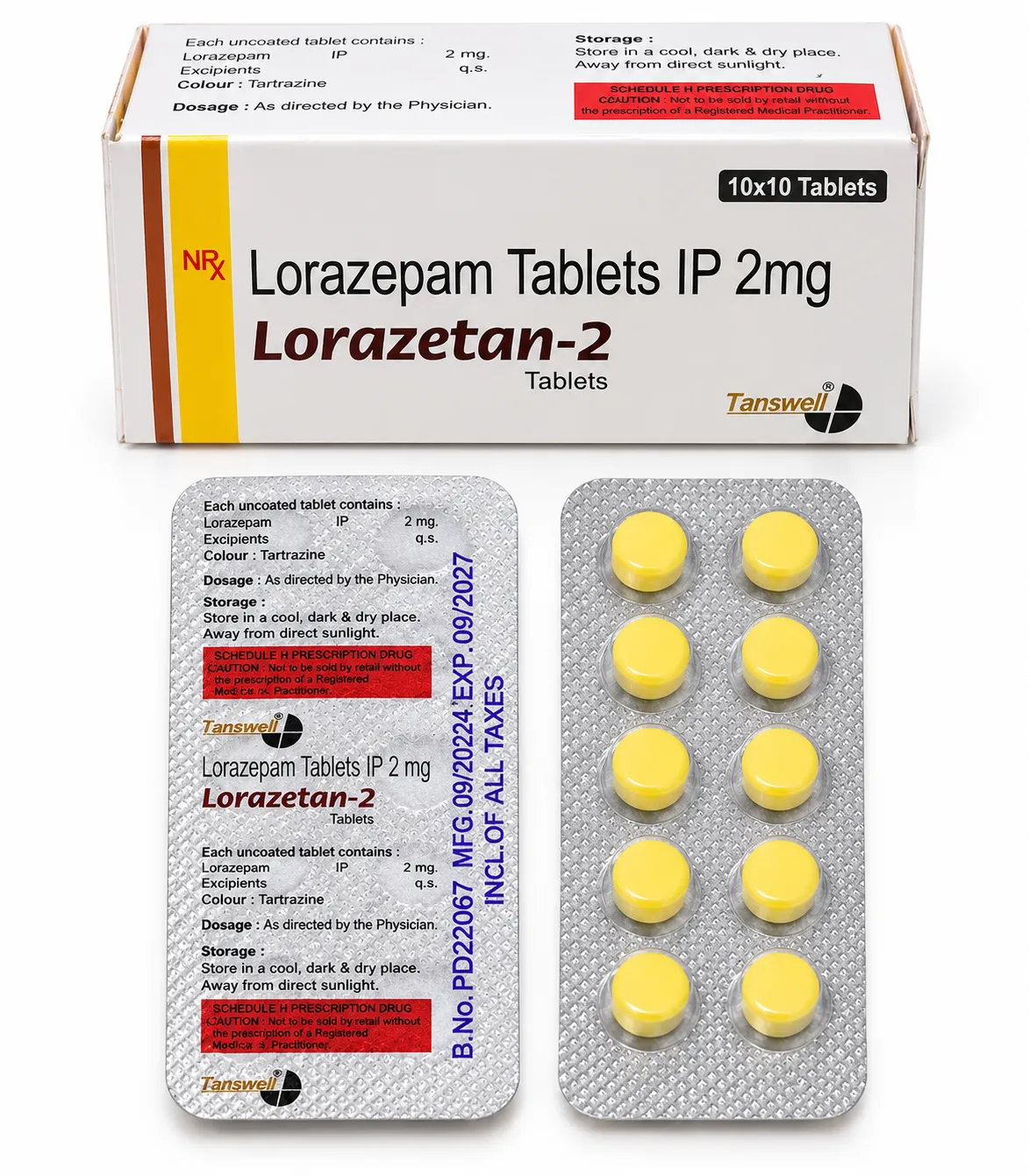
Ativan Pfizer 2mg (Lorazepam)
Original manufacturer formulation for acute panic attacks, severe anxiety states, and pre-anesthetic sedation.

Lorazepam 2mg Generic
Therapeutically equivalent generic 2mg oral tablets in tamper-evident sealed packaging.
10. Frequently Asked Questions
Why can’t I just cut my lorazepam dose in half to quit faster?
Cutting your dose in half is far too drastic. It removes the brain’s calming GABA signals too quickly, triggering severe withdrawal symptoms like panic, tremors, hallucinations, and potentially dangerous seizures.
What is the Ashton Method for tapering lorazepam?
The Ashton Method is a medically proven protocol where your doctor slowly replaces lorazepam with diazepam (Valium). Because diazepam lasts much longer in the body, it provides a smooth, gradual taper without painful withdrawal spikes.
How long does a proper lorazepam taper take?
A safe taper typically takes anywhere from 3 months to 9 months depending on your starting dose and how long you have been taking it. Slow, steady tapers have the highest success rates.
Can propranolol help during lorazepam withdrawal?
Yes. Doctors often prescribe propranolol (a beta-blocker) during a taper to control physical symptoms of anxiety like rapid heart rate, sweating, and trembling without affecting benzodiazepine receptors.
11. Clinical References & Regulatory Sources
- Ashton CH. Benzodiazepines: How They Work and How to Withdraw (The Ashton Manual). Newcastle University. Source Database.
- The British Journal of Psychiatry. Slow tapering vs. rapid withdrawal of long-term benzodiazepine users: A randomized controlled trial. Source Database.
- JAMA Internal Medicine. Deprescribing Benzodiazepines and Z-Drugs in Older Adults: A Systematic Review and Meta-analysis. Source Database.
Consult a Clinical Pharmacy Specialist
Have questions regarding Lorazepam dosing intervals, CYP enzyme interactions, or physician-guided discontinuation protocols? Connect with our licensed clinical pharmacy team for patient safety guidance.
Related Patient Services & Verified Care
Every prescription order is verified by a licensed pharmacist in strict adherence to FDA BeSafeRx protocols.