
Zolpidem Side Effects & Complex Sleep Behaviors: Sleep-Driving, Amnesia, and the FDA Boxed Warning

Zolpidem Side Effects & Complex Sleep Behaviors: Sleep-Driving, Amnesia, and the FDA Boxed Warning
A comprehensive clinical review of zolpidem adverse effects, focusing on parasomnias, anterograde amnesia, sleep-driving incidents, and the FDA black-box contraindication.
FDA BOXED WARNING MONOGRAPH
EXECUTIVE CLINICAL SUMMARY
While Zolpidem is highly effective for accelerating sleep onset, it carries an FDA Boxed Warning for Complex Sleep Behaviors (CSBs)—potentially life-threatening parasomnias occurring while not fully awake. Documented behaviors include sleep-driving, preparing and eating food, making telephone calls, having sexual encounters, and sleepwalking, with complete retrograde amnesia for the event the next morning. If a patient experiences a single episode of complex sleep behavior, zolpidem must be immediately and permanently discontinued.
01. The FDA Boxed Warning: Complex sleep behaviors, injuries, and fatalities
In April 2019, the FDA added its most prominent Boxed Warning to all prescription sedative-hypnotic medications (zolpidem, eszopiclone, zaleplon) after identifying 66 cases of severe injuries and 20 fatalities directly resulting from complex sleep behaviors. Fatalities involved motor vehicle collisions during sleep-driving, accidental hypothermia, drowning, gunshot wounds, and falls from windows or balconies.
| ADVERSE MANIFESTATION | INCIDENCE / REPORTED RATE | NEUROLOGICAL DRIVER | CLINICAL DIRECTIVE & MANAGEMENT |
|---|---|---|---|
| Complex Sleep Behaviors (CSB) | 0.5% – 2% (elevates with alcohol) | Selective cortical α1 dissociation | PERMANENT DISCONTINUATION: Never re-prescribe. |
| Anterograde Amnesia | 2% – 5% (higher if awake post-dose) | Hippocampal α1 encoding suppression | Take immediately prior to bed; do not remain upright. |
| Next-Day Somnolence / Hangover | 5% – 15% (higher in women on 10mg) | Lingering morning drug concentration | Enforce 5mg female dose cap; verify 7-8h sleep window. |
| Dizziness / Daytime Ataxia | 5% – 8% | Subcortical sensorimotor damping | Fall prevention precautions, especially in seniors. |
| Nighttime Hallucinations / Delirium | 1% – 2% | Thalamocortical sensory uncoupling | Dose reduction; screen for concurrent SSRI polypharmacy. |
02. Anterograde amnesia and the “twilight state” hazard
Zolpidem induces rapid, potent suppression of memory consolidation circuits in the hippocampus. If a patient ingests zolpidem but remains awake (e.g., checking email, preparing food, conversing with housemates), they enter an amnesic “twilight state” wherein they appear alert and functional to outside observers but will have complete amnesia for all conversations and actions the following morning.
03. Next-morning psychomotor impairment and simulated driving studies
Controlled driving simulator studies conducted by the FDA demonstrated that blood zolpidem concentrations exceeding 50 ng/mL produce significant lane-deviation and delayed braking reaction times. Morning impairment is particularly pronounced in women, elderly patients, and individuals who woke up fewer than 7 to 8 hours after dosing.
04. Gastrointestinal and central nervous system tolerability
Beyond parasomnias, common somatic side effects include mild nausea (3% to 6%), dizziness (5%), headache (7%), and dry mouth. These symptoms are generally mild, transient, and attenuate after the first few days of therapy.
05. Contraindications and absolute prohibitions
Zolpidem is strictly contraindicated in: 1. Any patient with a documented history of complex sleep behaviors after taking zolpidem or other Z-drugs; 2. Patients with severe sleep apnea syndrome; 3. Patients with severe hepatic failure (cirrhosis); 4. Severe myasthenia gravis.
06. Detailed Hypnotic Neurobiology, Selective α1 GABA-A Modulation & Sleep Architecture
At the molecular level, Zolpidem (zolpidem) is a non-benzodiazepine hypnotic belonging to the imidazopyridine chemical class. Unlike classical benzodiazepines that bind non-selectively across all α1, α2, α3, and α5 subunit-containing GABA-A receptors, zolpidem exhibits high preferential affinity and positive allosteric selectivity for the α1 subunit-containing GABA-A receptor complex (classically designated the benzodiazepine-1 or BZ1 receptor subtype).
The α1 subunit is localized primarily in the cerebral cortex, substantia nigra, and sensorimotor relay nuclei of the thalamus—regions responsible for regulating vigilance, cortical arousal, and sleep latency. By selectively augmenting GABA-stimulated chloride conductance at α1 complexes, zolpidem rapidly induces hypnotic slumber while producing significantly less muscle relaxation, anxiolysis, or anticonvulsant activity compared to non-selective agents.
| GABA-A SUBUNIT ISOFORM | ZOLPIDEM BINDING AFFINITY | NEUROANATOMICAL DISTRIBUTION | PRIMARY CLINICAL EFFECT |
|---|---|---|---|
| α1 Subunit (BZ1) | High Affinity (Ki ~19 nM) | Cerebral cortex, thalamus, substantia nigra | Rapid sleep latency reduction, hypnotic induction, slow-wave sleep |
| α2 Subunit (BZ2) | Low Affinity (Ki >180 nM) | Limbic system, amygdala, striatum | Minimal daytime anxiolysis at standard hypnotic doses |
| α3 Subunit (BZ2) | Low Affinity (Ki >250 nM) | Spinal interneurons, reticular formation | Negligible peripheral muscle relaxation |
| α5 Subunit (BZ3) | Negligible Affinity (Ki >1,000 nM) | Hippocampus, temporal lobe memory circuits | Preserved temporal memory formation outside peak sedation |
Polysomnographic sleep architecture studies demonstrate that zolpidem preserves physiological sleep stages, maintaining Stage 3 and Stage 4 deep slow-wave sleep and exerting minimal disruptive impact on rapid eye movement (REM) sleep when administered at recommended therapeutic doses.
07. Hepatic Clearance, Renal Impairment & Beers Criteria Safety
Clinical dosing of Zolpidem requires strict gender-specific and hepatic impairment adjustments due to substantial clearance differences:
| PATIENT SUBGROUP | CLEARANCE KINETICS & AUC | FDA RECOMMENDED DOSING | CLINICAL SAFETY MANDATE |
|---|---|---|---|
| Adult Females | 45% lower oral clearance than males (higher morning Cmax) | 5mg immediately before bedtime | Reduces next-morning driving impairment |
| Adult Males | Standard oxidative hepatic clearance via CYP3A4 | 5mg to 10mg immediately before bedtime | Do not exceed 10mg; allocate 7-8 hours sleep |
| Geriatric Patients (≥ 65 Years) | Prolonged elimination half-life (~3.0 to 4.0 hours) | 5mg immediately before bedtime maximum | Beers Criteria warning: fall risk and nocturnal confusion |
| Hepatic Impairment (Child-Pugh A/B) | 5-fold increase in AUC, Cmax doubles | 5mg maximum; avoid in severe cirrhosis | Contraindicated in severe hepatic failure |
Under FDA black-box warnings and AGS Beers Criteria®, sedative-hypnotics must be prescribed at the lowest effective dose for the shortest possible duration (typically ≤7 to 10 days) to prevent physical dependence, tolerance, and nocturnal confusion.
08. Comprehensive Patient Clinical Safety & Dispensing Checklist
Before administering Zolpidem, patients and caregivers must verify this pre-dose safety checklist to prevent dangerous sleep-state emergencies:
PRE-BEDTIME CLINICAL SAFETY CRITERIA
- Bedside Timing Rule: Ingest tablet immediately prior to getting into bed—never 30 or 60 minutes beforehand while walking around the home.
- 7 to 8-Hour Dedicated Sleep Window: Only take zolpidem if you have at least 7 to 8 full hours to dedicate to uninterrupted sleep before waking.
- Complex Sleep Behavior Warning: Discontinue immediately if sleep-walking, sleep-driving, preparing food while asleep, or making phone calls without memory occurs.
- Alcohol & CNS Depressant Ban: Zero alcohol consumption on the evening of administration; never combine with opioids or tranquilizers.
- Empty Stomach Administration: Take on an empty stomach; food delays sleep onset and lowers peak therapeutic levels.
09. Verified Pharmaceutical Formulations & Prescribing Profiles

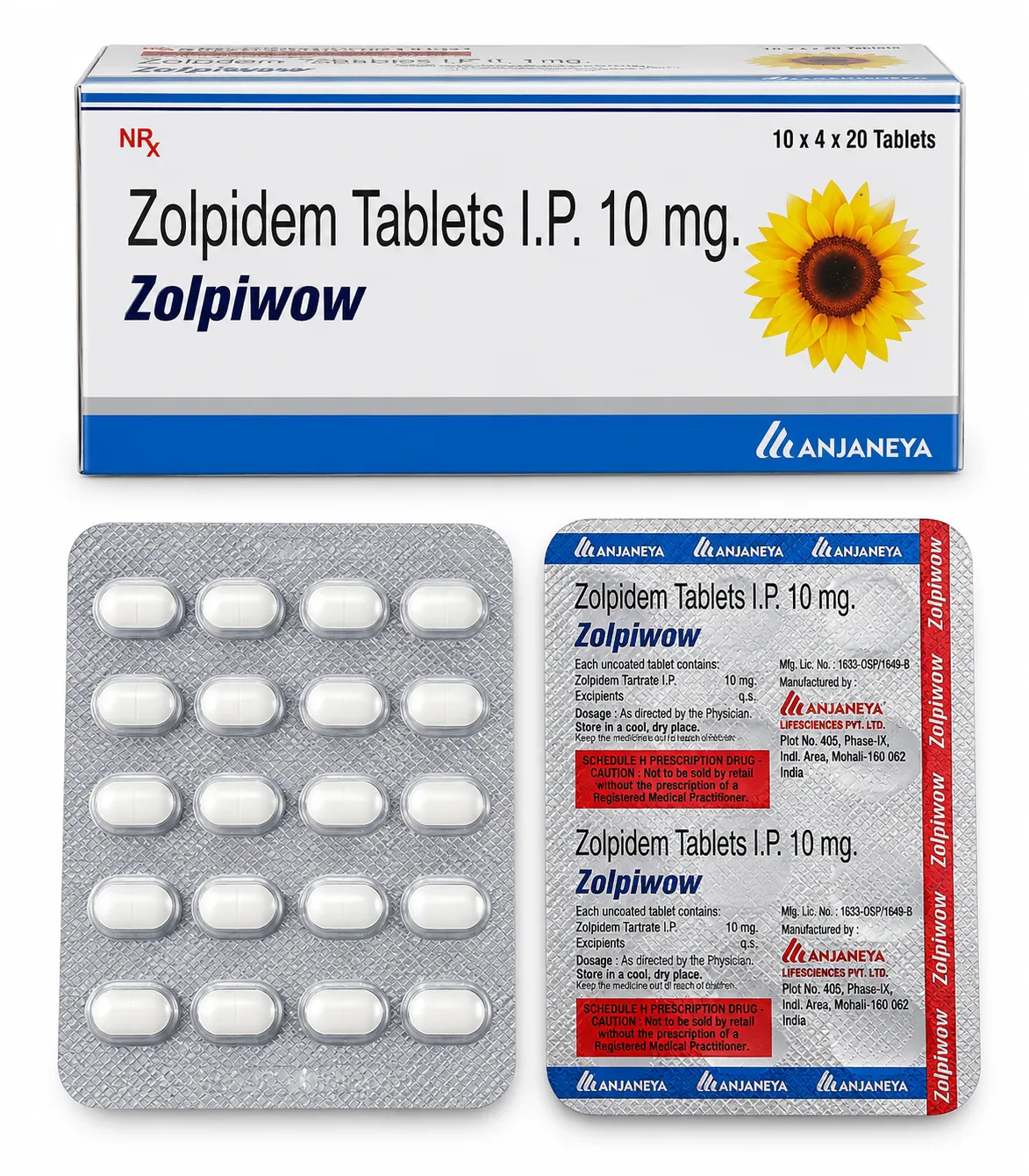
Zolpidem 10mg (Zolpiwow / Ambien Class)
Selective α1 GABA-A receptor hypnotic indicated for the short-term treatment of sleep-onset insomnia, accelerating sleep latency with minimal slow-wave disruption.
10. Frequently Asked Questions
What is “sleep-driving” on zolpidem and how does it happen?
Sleep-driving occurs when zolpidem suppresses the brain’s conscious memory centers while leaving motor functions partially active. The person drives a car while essentially asleep, with zero memory of the event the next morning.
What should a patient do if they wake up to find they prepared food or walked in their sleep?
Stop taking zolpidem immediately and call your doctor. Under FDA black-box warnings, experiencing even one episode of complex sleep behavior means you must never take zolpidem again.
Why does zolpidem cause temporary memory loss (amnesia)?
Zolpidem shuts down the brain’s ability to record new memories while it is active. If you take the pill and stay out of bed instead of going straight to sleep, you will not remember what you did during that time.
Is it safe to drive to work the morning after taking zolpidem 10mg?
Only if you had at least 7 to 8 full hours of sleep and feel completely alert. If you feel groggy, dizzy, or “foggy,” your driving is impaired and you should not drive.
Can zolpidem cause hallucinations?
Yes. In about 1% to 2% of patients—especially those taking antidepressants or fighting sleep after taking the pill—zolpidem can cause strange visual distortions or mild hallucinations.
11. Clinical References & Regulatory Sources
- FDA CDER. FDA Drug Safety Communication: FDA takes measures to prevent serious injuries caused by uncommonly complex sleep behaviors. Source Database.
- New England Journal of Medicine. Complex sleep-related behaviors and sedative-hypnotic medications. Source Database.
- American Academy of Sleep Medicine (AASM). Position Statement on Complex Sleep Behaviors. Source Database.
Consult a Clinical Pharmacy Specialist
Have questions regarding Zolpidem dosing intervals, CYP enzyme interactions, or physician-guided discontinuation protocols? Connect with our licensed clinical pharmacy team for patient safety guidance.
Related Patient Services & Verified Care
Every prescription order is verified by a licensed pharmacist in strict adherence to FDA BeSafeRx protocols.